
The Board is accountable to the Group’s stakeholders for exercising leadership, integrity and judgement in directing Super Group to achieve profitability by ensuring the necessary balance between entrepreneurship and conformance with best business and corporate governance practices.
The Board also acknowledges its responsibilities in accordance with the recommendations of King IV™, specifically Principles 1, 2 and 3 of the Code, vis-à-vis leading ethically and effectively, governing the ethics of Super Group in a way that supports the establishment of an ethical culture, and ensuring that the organisation is, and is seen to be a responsible corporate citizen. The Board further acknowledges that it should serve as the focal point and custodian of the corporate governance in the organisation as outlined in Principle 6 of King IV™.
The Board’s primary functions and responsibilities include:
- Approving the strategic direction of Super Group.
- Confirming strategic objectives and key policies and ensuring communication of these to applicable management levels.
- Monitoring the implementation of management’s plans and strategies.
- Reviewing and approving overall policies and processes to maintain the integrity of the Group’s risk management and internal controls.
- Determining and defining investment and performance criteria.
- Reviewing and approving the annual business plan and budget and monitoring performance against budget.
- Identifying and continually reviewing key risks, as well as the mitigation thereof by management, against a background of economic, environmental and social issues.
- Monitoring of financial and internal control development.
- Continually rating the Group’s own performance relative to budgets, competitors and prevailing economic conditions.
- Approving major capital expenditure programmes, significant acquisitions and disposals.
- Approving investment, divestment, refinancing and restructuring transactions.
- Reviewing and approving the Group’s half-year and full‑year results.
- Reviewing and approving the Integrated Report, including approving management’s basis for determining materiality for deciding which information is included in the Integrated Report.
- Determining the arrangement for assurance with respect to the information included in the Integrated Report.
- Developing and implementing employment equity plans.
- Developing and implementing employee development and remuneration plans, including share scheme management.
- Approving the nomination of new candidates to the Board, as well as the process for nomination, election and appointment to the Board.
- Appointing the CEO and monitoring the succession plan.
- Evaluating the performance of all directors.
- Overseeing that the organisation’s purpose and values, strategy and conduct are in keeping with it being a responsible citizen as follows:
- Overseeing and monitoring how Super Group’s activities and outputs affect its status as a good corporate citizen.
- Reviewing and approving the Group’s plan for community-based development, sponsorship and donations.
- Exercising oversight over the Group’s stakeholder relationship management.
- Reviewing and approving Super Group’s Code of Conduct and Ethics policies.
- Reviewing and approving the Group’s environmental and OHS plans.
- Overseeing the assessment and response to any potential negative consequences of the Group’s activities and outputs.
- Formally reviewing the adequacy and effectiveness of the organisation’s technology and information function, ensuring it complies with certain disclosure requirements with respect to technology and information.
- Ensuring that technology and information in the Group is governed in a way that supports the organisation setting and achieving its strategic objectives. This includes the management, protection and oversight of technology and information, including the development of a ‘cyber security plan’.
Composition of the Board
A key aspect of the Group’s governance philosophy is that no one individual has unfettered powers of decision-making. As at year end, the Board comprised of five non-executive directors and two executive directors and was chaired by a non-executive chairman. Due to the tenure of the chairman exceeding 12 years, a Lead Independent Director was appointed effective 30 September 2020. At the date of this report, the Board composition remained the same. The non-executive directors exert significant influence at meetings. From time to time the non-executive directors meet without the executive directors present. In considering the composition of the Board, competency in respect of the Group’s affairs carries as much weight as independence. The roles of CEO and Chairman of the Company are split.
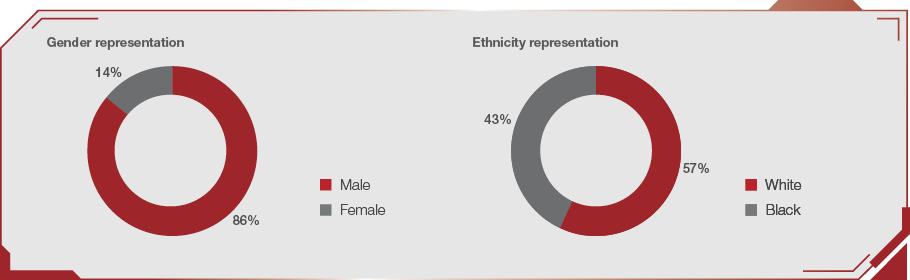
The Board considers its composition including its chairmanship annually. It also has a Gender and Race Policy which deals with equality at Board level. At the date of this report, Super Group had only one BEE female as a non-executive director (representing 14% of the Board). The target is to have at least a 10% female representation on the Board, which has been met. The target for BEE representation on the Board is 50% by June 2022.
The Board has considered the chairmanship of Phillip Vallet and, although in terms of King IV™, he is no longer regarded as independent due to his tenure of 11 years as Chairman of the Company. The Board agrees that he remains the best person to lead the Company and the Board. Mr Vallet, previous senior partner and CEO of Fluxmans Inc. (Fluxmans), retired in February 2020 and continues to consult to them on an executive basis. Fluxmans assist Super Group with corporate law advisory services in respect of various transactions and several other corporate and labour matters. As a result, and in terms of King IV™, Mr Valentine Chitalu has been appointed as Lead Independent Director effective 30 September 2020.
While retaining overall accountability and subject to matters reserved to itself, the Board has delegated to the executive directors’ authority to run the day-to-day affairs of the Group. The executive directors are held accountable through regular reports to the Board and are measured against agreed performance criteria and objectives appropriate to the current stage in the business cycle and the prospects in each business unit. The executive directors meet and interface with senior executives regularly. The objective of these meetings is to assist the CEO in guiding and controlling the overall direction of the Group and to act as a medium of communication and coordination between operating divisions and the Board.
Each of the directors brings to the Board a wide range of expertise, commercial and technical experience and business acumen that allow them to exercise independent judgement in Board deliberations and decisions. Non-executive directors have unrestricted access to management.
The curriculum vitae of the members of the Board as well as an analysis of their combined skills can be found here.
Code of Ethics and Business Conduct
Super Group is committed to high standards of honesty, integrity, behaviour and ethics in dealing with all stakeholders. All directors and employees of the Group are encouraged to subscribe to the Super Group Code of Ethics and Business Conduct, which requires them to maintain high personal ethical standards and to act in good faith and in the best interests of the Group. The code also addresses conflicts of interest, particularly relating to directors and management. This ensures that the Group’s business practices are conducted in an equitable manner. Employees are surveyed annually to ensure they are both aware of and understand the Group’s Code of Ethics and Business Conduct.
No director or employee of the Group may deal, either directly or indirectly, in the Company’s shares whilst having knowledge of unpublished price-sensitive information regarding its business or affairs. No director or officer of the Group may trade in the Company’s shares during the closed embargo periods determined by the Board in terms of a formal policy implemented by the Group Company Secretary. Any trading in shares by directors of Super Group and the Group Company Secretary, as well as the directors of major subsidiary companies of Super Group, must be approved in writing by the Group CEO and, any trading in shares by the Group CEO must be approved in writing by the Chairman of the Company, prior to any such trade taking place.
Periods of embargo are from the end of a reporting period to the announcement of financial results and from the date of a cautionary announcement until a terms announcement. A register of directors and officers is available for inspection at the Company’s registered office in Sandton, South Africa.
Board meetings and director attendance
Board meetings are held at least quarterly and additional meetings are convened when necessary should a particular issue demand attention. Board meetings are convened by formal notice incorporating a detailed agenda supported by relevant written proposals and comprehensive reports. Management aims to disseminate meaningful, relevant and complete information in a timely manner prior to Board meetings. Where necessary, decisions are taken between Board meetings by written resolution as provided for in the Company’s Memorandum of Incorporation.
The non-executive directors are of the view that the Group’s Governance Framework and the Board’s role therein are sufficient and that there were no major shortcomings in the Group’s governance.
Details of attendance by directors of Board and committee meetings for the year under review are set out below:
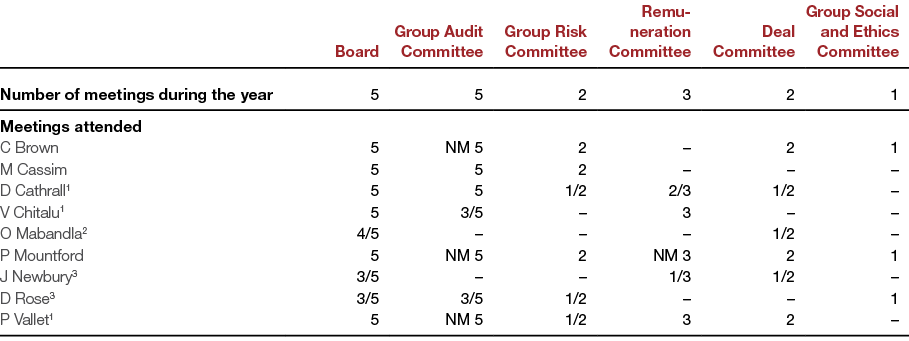
| 1 | Due to Board changes announced on 26 November 2019, some of the newly elected committee members did not attend the meetings prior to the 26 November 2019. |
| 2 | Mr O Mabandla resigned effective 8 July 2020. |
| 3 | Mr J Newbury and D Rose both retired effective 30 November 2019. |
| NM: Non-member, do attend committee meetings by invitation. |
Members of the Board have unlimited access to the Group Company Secretary. Where appropriate, advice of independent professionals may be sought by any Board member, the cost of which is borne by the Company.

Board appointments
The non-executive directors have no fixed terms of appointment as they are subject to reappointment by the shareholders every three years. Non-executive directors will retire from the Board at the age of 75. Where circumstances require, the retiring director may be retained on the Board.
Peter Mountford, the CEO, has a written letter of appointment that endures indefinitely and is subject to termination on one month’s notice. The CEO is a director of SG Fleet Group, the Group’s subsidiary company listed on the Australian Stock Exchange. He sits on the board of the Road Freight Association. Colin Brown, the CFO, has a written letter of appointment that endures indefinitely and is subject to termination on two months’ notice. There are no specific contractual terms in respect of the termination clauses for both executives. Both executives have change of control clauses in their letter of appointment.
One-third of the non-executive Board members are required to retire by rotation every year and, if eligible, are considered for re‑appointment at the AGM.
Any new appointment is considered by the Board sitting as a Nominations Committee. The experience and skills required for the position are agreed by the Board and a shortlist of candidates is prepared. The curriculum vitae of the candidates are circulated to all Board members. The Board will nominate two or three of the Board members to interview the candidates. The outcome of the interviews is then reported to the Board sitting as a Nominations Committee. The Board will then select the successful candidate. Interim Board appointees are required to retire at the next AGM where they make themselves available for election by the shareholders.
Board changes during and subsequent to the year ended 30 June 2020
Mr John Newbury and Mr David Rose both retired from the Board on 30 November 2019 and the changes to the membership of the Board committees were announced on SENS on 26 November 2019.
Mr Oyama Mabandla tendered his resignation effective 8 July 2020 due to an unforeseen conflict of interest. Ms Mariam Cassim will be resigning effective 30 November 2020 due to increased executive commitments.
Ms Pitsi Mnisi and Mr Simphiwe Mehlomakulu were both appointed to the Board effective 1 October 2020.
Mr Valentine Chitalu was appointed as Lead Independent Director effective 30 September 2020.
There were no further Board changes for the year under review to the date of publishing the Integrated Report and ESG Report.
Evaluation of the Board
The Chairman of the Company, assisted by the Group Company Secretary, carried out a comprehensive evaluation of the Board, its committees and directors. The contributions of the directors to both the Board and the Board committees were evaluated and the effectiveness of the Board and its committees in carrying out their mandates was also assessed. The Chairman and the Group Company Secretary concluded that the Board and its committees are operating effectively. An evaluation of the Board was performed in August 2019. The next evaluation of the effectiveness of the Board and its committees will be performed before the end of the 2021 financial year.
All the directors have contributed their time and skills to the functioning of the Board. The Chairman of the Company recommends the director who is nominated for election or re-election at the AGM as competent and dedicated to serving the Group and looking after the interests of the stakeholders.
Group Company Secretary
John Mackay is the Group Company Secretary. The Group Company Secretary plays a vital role in the corporate governance of the Group. The Group Company Secretary is responsible to the Board for, inter alia, ensuring compliance with procedures and applicable statutes and regulations. To enable the Board to function effectively, all directors have full and timely access to information that may be relevant to the proper discharge of their duties. This includes information such as corporate announcements, investor communications and other developments which may affect the Group. This also includes access to management, where required.
Mr Nigel Redford, the previous Group Company Secretary, retired on 31 December 2019 and Mr John Mackay was appointed Group Company Secretary effective 1 January 2020. Due to the change in the Group Company Secretary as well as Covid-19 lockdown during the year, the Board has not conducted an evaluation of the Group Company Secretary’s effectiveness, qualification and experience and ensured that he maintains an arms-length relationship with the Board. This evaluation will be performed in the next financial year. The appointment and removal of the Group Company Secretary is a matter for the Board as a whole. The Group Company Secretary’s Certificate is set out here.