Employment equity and transformation
The directors believe that economically viable and self-sustaining employment equity is an essential and integral part of corporate governance within all Group businesses. Accordingly, the Board has approved a Group Employment Equity Policy. In compliance with the Group policy, management of the various business units has initiated a variety of employment equity programmes.
Individual development, equality and performance-based advancement are the cornerstones of Super Group’s approach to bring and maintain a balanced and highly skilled workforce.
The Group has embarked upon a broad-based initiative with the intention of impacting on the lives of all of its employees, their families and the communities in which they live. The Group believes that this approach will ensure that its employees become responsible individuals, citizens and parents. Super Group’s success, in part, is as a result of its dedicated and committed employees.
On 1 October 2012, the shareholders of Super Group approved a B-BBEE Scheme for the Black (as defined by the BEE Act) staff. The Group has empowered its South African operations by allocating an effective 10.04% ownership of Super Group Holdings to the Black South African Super Group employees.
Super Group Holdings has a B-BBEE Level 1 Contributor status, which meets the Group’s transformation target.
Gender equality
Super Group’s goals towards achieving gender equality are guided by the principle of fairness which incorporates acceptance of equal and inalienable rights of all women and men as defined in the Bill of Rights of the Constitution of the Republic of South Africa, 1996 (Act 108 of 1996).
Gender equality concerns both women and men. It involves working with both to ensure equitable behaviours are practised at home and in the workplace. Genuine equality cannot be measured by parity in numbers, but rather by improving overall quality of life so that equality is achieved without sacrificing gains for males or females.
Our core values and fundamental principles of good governance as well as the rule of law, form the basis when assessing gender equality to ensure that we treat everyone with respect and understanding to ultimately motivate economic and social development.
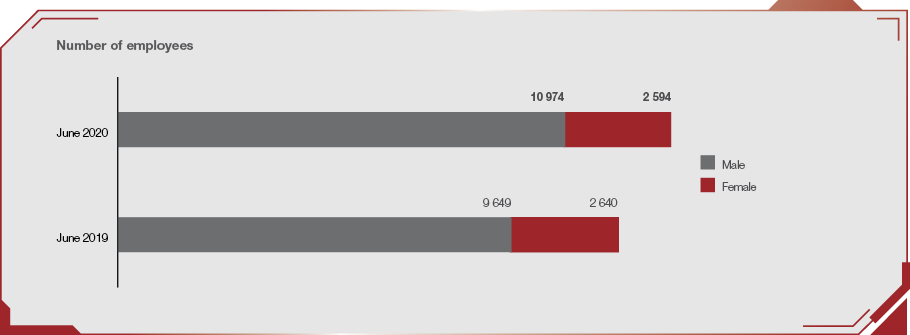
As at 30 June 2020, females represented 19% of the Group’s workforce. Due to the nature of the Group’s operations, the female employment target is set at 20%.
Headcount statistics
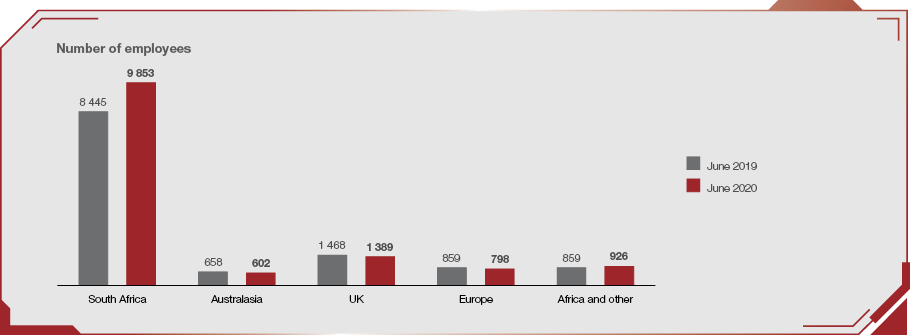
Headcount per geography
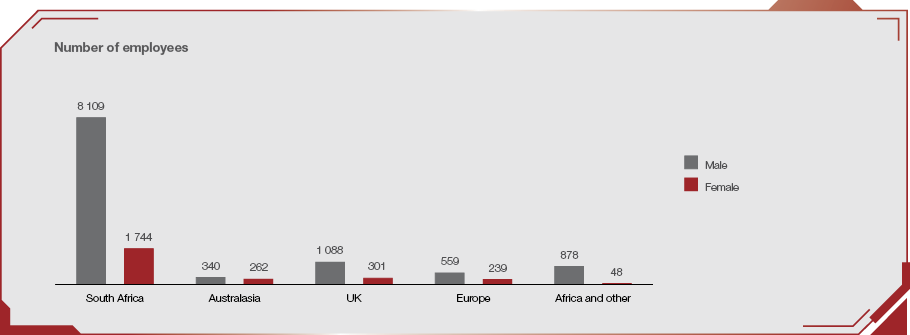
For the year ended 30 June 2020, Super Group employed 13 568 (2019: 12 289) permanent employees, of whom 72.6% (2019: 68.7%) are based in South Africa, 6.8% (2019: 7.0%) based in sub-Saharan Africa, 4.4% (2019: 5.4%) are based in Australasia, 10.2% (2019: 11.9%) in the UK and 6.0% (2019: 7.0%) in Europe.
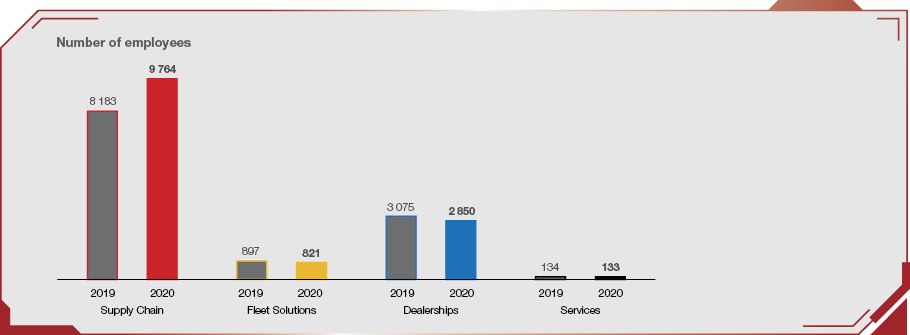
Headcount per division
The headcount within Supply Chain Africa increased as a result of the various acquisitions made during the year. The headcount for Super Group’s divisions is are follows:
Headcount per gender
Male employees constituted 81% (2019: 79%) of Super Group’s workforce.
Employees per gender per geography are as follows:
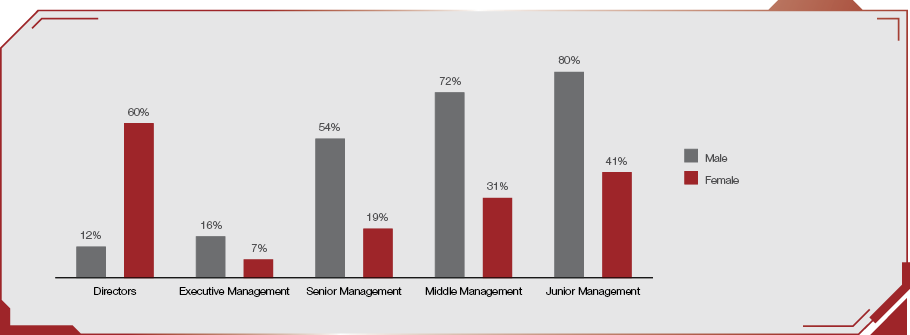
B-BBEE gender representation for management in South Africa:
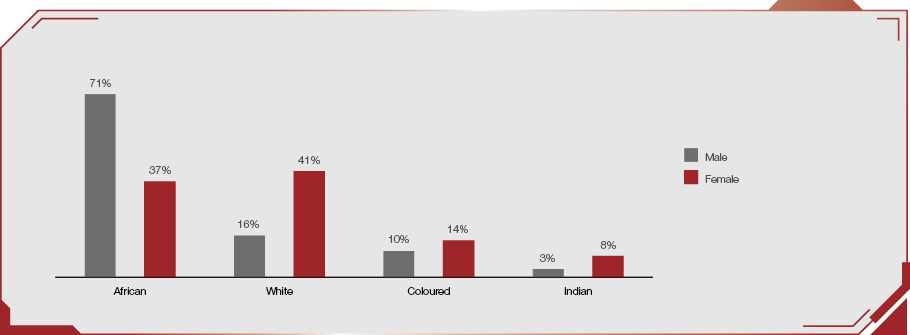
Headcount per ethnic group
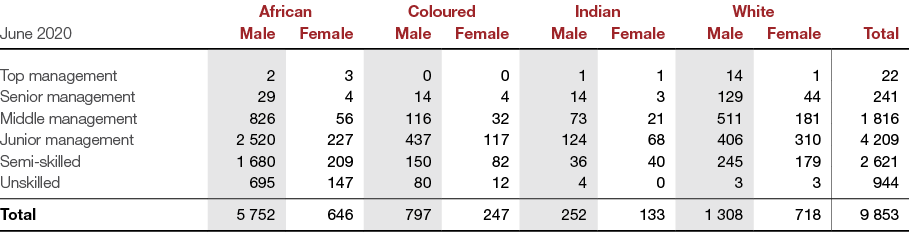
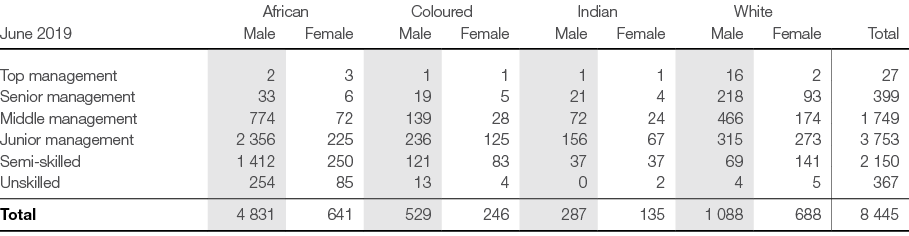
Super Group’s South African employees are represented by the following ethnic groups:
The South African employees’ positions within the Group:
Employee health and wellness
The directors acknowledge their statutory and moral responsibility to employees and the public to comply with OHS standards. The Board is responsible for ensuring the adequacy and effectiveness of the application of the overall health, safety and environmental policies of the Group. The Group Health and Safety Manager, who reports to the Group CFO, is tasked with, inter alia, conducting compliance audits across all operating sites controlled by the Group, and reports thereon to the relevant levels of management who are obliged to undertake any required remedial actions within agreed time frames. The Group Health and Safety Manager shares best practice and other information with managers tasked with implementing compliance with the OHS Act. The Group CFO tables a report on the outcome of the OHS compliance audits at the Group Risk Committee.
The Group has a comprehensive Health and Wellness Policy that is available to all employees on the Group’s intranet as well as included in each new employee’s starter pack.
The policy addresses life-threatening diseases which include, but are not limited to, AIDS, cancer, chronic obstructive airways disease, heart disease and tuberculosis. The policy provides comprehensive background information about HIV and AIDS and some of the key issues covered include:
- Confidentiality of medical information and employee privacy;
- Voluntary testing with counselling;
- Non-discrimination;
- Support for ill employees;
- The employees’ duty to report to their manager when they are not well enough to perform their duties and may endanger their colleagues;
- Managers’ duties and responsibilities to ill employees; and
- Health education.
The Group hosts wellness days for its employees at various sites. The Supply Chain Division also participates in the Trucking Wellness Programme which is a Road Freight Association project where mobile clinics focus on the wellbeing of the truck drivers and support staff and the message of wellness and information about HIV and AIDS is given.
Occupational Health and Safety
The Group continued with its emphasis on OHS during the financial year, especially during the Covid-19 lockdown periods this year. The OHS Officer visited every one of the Group’s South African operations during the year and during the lockdown period, every employee’s temperature was taken before being allowed on the premises. He identified issues and, in conjunction with site management, developed plans to address problem areas. Significant focus continues to be placed on the training of Safety Officers and First Aiders.
The Group had 261 employees who tested positive for Covid-19 during the year under review. The majority of these employees self‑isolated and were a-symptomatic. We unfortunately had two fatalities as a result of this devastating pandemic and our sincere condolences to their families.
The number of accidents for the year ended 30 June 2020 increased to 481 (2019: 332) cases and are set out in the graph below, mainly due to the unacceptable condition of our road infrastructure, the increasing criminal attacks on trucks and the lawlessness of drivers on our roads.
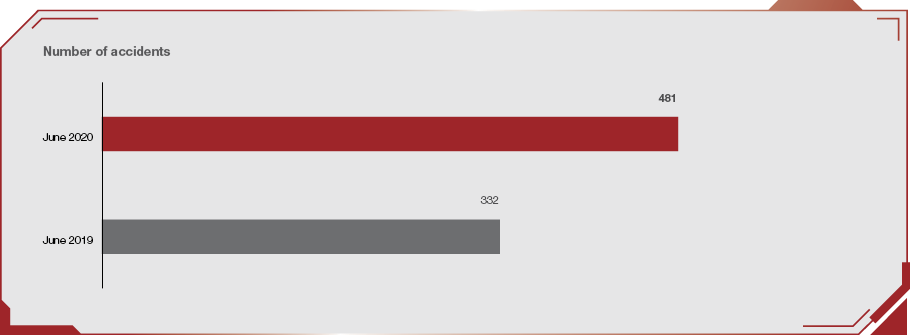
Meaning of an accident is an unplanned event that results in harm to people, damage to property or loss of process.
The total number of accident cases per business division for the years ended 30 June 2019 and 2020 are set out in the graph below:
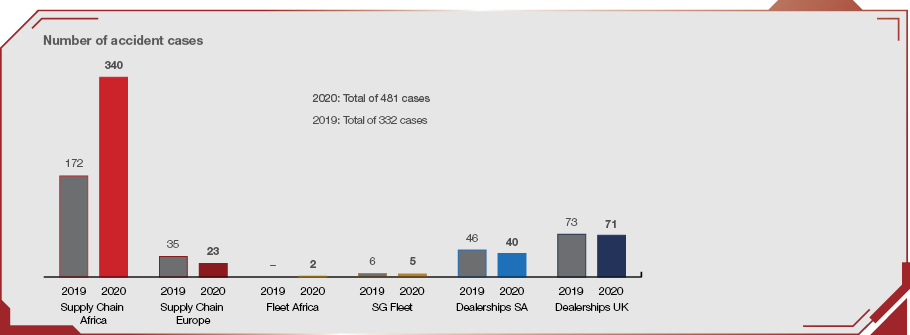
The Group had two fatalities (2019: one) for the year ended 30 June 2020 as a result of accidents. Our condolences go out to the families and we continue to strive for a zero fatality rate.
A number of Super Group’s operations are ISO9001:2008 accredited.
Enterprise and supplier development
Super Group Holdings spent 1.14% of its profit before tax for the financial year ended 30 June 2020 on enterprise and supplier development.
Skills development and diversity
The Group has embarked on extensive skills development initiatives which include Learnership, Apprenticeship and Management Development Programmes. These programmes focus on the up-skilling of staff as well as unemployed learners in order to increase productivity and know-how in the business and have been a major priority for the past two years and will be for the next three years.
The Group’s Skills Development strategy, a sub-component of the Group’s B-BBEE strategy covered various skills development initiatives over the reporting period, including but not limited to Learnerships, Apprenticeships and Internships for both employed learners and unemployed learners. In the interest of diversity, the Group’s Skills Development strategy included both able-bodied and disabled learners mirroring the Economic Active Population demographics of the country participated in skills development programmes.
During the financial year ended 30 June 2020, 20% (2019: 32%) of Super Group’s staff received training. Formal training programmes included, amongst others, the following:
- Automotive Apprenticeships,
- Learnerships in Business,
- Freight Handling,
- Transport,
- Call Centre and
- Professional Driving.
Internal training is also carried out regularly to ensure the building of skills as well as to stay up to date with industry changes.
In addition, 172 (2019: 222) unemployed Black learners as well as 32 (2019: 20) disabled Black ladies were recruited to participate in learnership programmes this past year and we expect that most of these learners would be absorbed into the business upon completion of their respective training programmes. During the financial year ended 30 June 2020, the Group invested more than 5% of its payroll cost on staff skills development.
The Group will continue to develop and promote Black staff through its development programmes and on-the-job training. The Group recognises that there is strength in diversity and that this will contribute towards a successful organisation in the future.
The value of goods and services from suppliers who are accredited B-BBEE Level 3 Contributors and better was 58.2% (2019: 54.5%) of the Group’s total spend.