

Super Group reported results for the year ended 30 June 2020 that reflect the challenging macroeconomic and trading conditions experienced across the various geographies in which the Group trades, as well as the significant negative impact of the novel coronavirus (Covid-19) pandemic.
The South African economy was already constrained before the pandemic and with the Covid-19 lockdown the economic and social environment has become significantly more demanding and uncertain. The South African national lockdown since 27 March 2020, as well as the partial lockdown arrangements applied in Australia, Germany, Spain and the UK have created major business disruptions and the Group’s trading has been severely impaired in all of these territories between March and June 2020.
The majority of Super Group’s Supply Chain operations and Fleet Africa were designated as essential service providers during the lockdown. The Group has in place a comprehensive suite of safety, health and hygiene protocols for the protection of all stakeholders, in particular staff and customers.
Super Group acquired a 65% interest in Lieben Logistics and a 51% interest in GLS effective 3 July 2019. The purchase price of Lieben Logistics was R498.8 million and the purchase price of GLS was R96.4 million. In January 2020, the Group acquired an additional 2.4% interest in Lieben Logistics for R13.1 million, taking its interest to 67.4%. Effective 1 March 2020, Super Group acquired an 80% interest in Zultrans, an express freight and distribution business, for a purchase consideration of R26.7 million. These businesses are incorporated into Supply Chain Africa.
Supply Chain Europe’s inTime business acquired an 80% interest in TLT, effective 5 July 2019 for R186.9 million.
The Group also acquired a further 2.6 million SG Fleet shares for a total of R60.1 million, thereby increasing its interest in SG Fleet to 60.13% as at 30 June 2020 (30 June 2019: 59.2%).
Super Group listed senior unsecured notes to the value of R750 million during the year under review (SPG008 for R250 million (3 years), SPG009 for R350 million (5 years) and SPGC01 for R150 million (12 months), in terms of the Company’s DMTN Programme.
THE YEAR AT A GLANCE
- Revenue decreased by 8.7% to R34.6 billion (June 2019: R37.9 billion)
- Operating profit decreased by 41.0% to R1 578.0 million (June 2019: R2 673.9 million)
- Headline earnings decreased by 59.7% to R546.6 million (June 2019: R1 354.7 million)
- Headline earnings per share decreased by 59.6% to 151.2 cents (June 2019: 373.8 cents)
- Earnings per share decreased by 114.4% to a loss of 52.1 cents (June 2019: profit of 360.8 cents)
- Cash generated from operations increased by 37.0% to R4.3 billion (June 2019: R3.1 billion)
- Net asset value increased by 3.3% to R13.0 billion (June 2019: R12.6 billion)
The adverse impact of the Covid-19 pandemic on revenue, operating profit and headline earnings was estimated at R5.2 billion, R932 million and R613 million, respectively.
FINANCIAL PERFORMANCE
Group revenue decreased by 8.7% to R34.6 billion (June 2019: R37.9 billion) mainly due to the tough trading conditions experienced across all of the Group’s operations. Some of these trading conditions pre-existed and were severely exacerbated by the onset of the Covid-19 pandemic at the end of the third quarter of the financial year ended 30 June 2020. Revenue lost during the second half as a result of Covid-19 is estimated to be R5.2 billion.
Super Group adopted the new IFRS 16 – Leasing Standard effective 1 July 2019, which had the following impact on the financial results:
- Decrease in revenue by R22.2 million
- Increase in EBITDA by R578.9 million
- Increase in operating profit by R142.5 million
- Decrease in profit before tax by R12.4 million
- ROU assets recognised amounted to R2 320.8 million
- ROU lease liabilities recognised amounted to R2 880.8 million
EBITA decreased by 37.1% to R1 788.2 million (June 2019: R2 842.9 million). Other than Fleet Africa, the majority of the other underlying divisions’ profitability was severely impacted by the weakened trading conditions. Operating profit decreased by 41.0% to R1 578.0 million (June 2019: R2 673.9 million). The estimated impact of Covid-19 on operating expenses includes retrenchment costs of approximately R31.4 million and cost of compliance to Covid-19 health and safety protocols of approximately R22.3 million. The Group estimated impact of Covid-19 on operating profit before tax was approximately R932 million.
The proportion of Super Group’s revenue and operating profit derived from its non-South African businesses was 46% (June 2019: 48%) and 43% (June 2019: 50%), respectively.
Total capital items amounted to R879.2 million (June 2019: R68.3 million) for the year under review. Super Group has made impairments against the carrying values of certain goodwill, intangible assets and properties, mainly against Supply Chain Europe (inTime) of R599.4 million, Dealerships SA of R183.6 million and Supply Chain Africa of R111.7 million. In addition, provisions for bad debts of R203.6 million were raised.
Our employees are key to the success of our Group. Our permanent workforce totalled 13 568 (June 2019: 12 289) employees across all regions as at 30 June 2020, an increase of 10.4%. The Group had 261 confirmed Covid-19 cases, equating to 1.9% of its employees as at 30 June 2020 with two fatalities to this terrible pandemic. Our condolences go out to the families.
Earnings per share decreased by 114.4% to a loss of 52.1 cents (June 2019: profit of 360.8 cents) and HEPS decreased by 59.6% to 151.2 cents (June 2019: 373.8 cents). The estimated impact of Covid-19 and IFRS 16 on HEPS was approximately 172 cents.
Net finance costs, excluding finance costs on ROU lease liabilities, increased by 17.1% to R405.8 million (June 2019: R346.5 million). Super Group’s net debt position, excluding IFRS 16’s ROU lease liabilities at 30 June 2020 was R3 142.1 million, an increase of R99.8 million, resulting in the net debt to equity (gearing) ratio, excluding ROU lease liabilities, to be in line with the 24.1% at 30 June 2019. The Group met its debt covenants and has sufficient debt facilities to meet its current obligations.
The covenants in the graphs below exclude SG Fleet and IFRS 16.
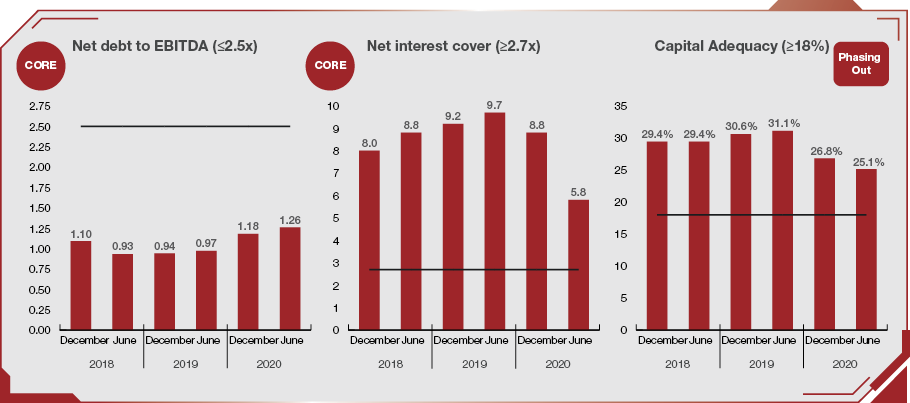
The net asset value per share increased by 2.6% from R30.37 at 30 June 2019 to R31.16 at 30 June 2020.
Total assets increased by 18.5% to R35.9 billion from R30.3 billion at 30 June 2019. The Group’s return on net operating assets, after tax, decreased to 6.3% from 12.6% at 30 June 2019 with the Group’s WACC being 9.4% (June 2019: 9.2%). The increase in the total assets includes the capitalisation of ROU assets of R2.3 billion in terms of IFRS 16.
Cash generated from operations increased by 37.0% for the year to R4 301.9 million (June 2019: R3 140.4 million). Working capital inflow of R854.6 million was recorded, compared to a cash outflow of R652.1 million in the prior year. Super Group spent R2.4 billion in net additions, acquisitions and share buybacks.
No dividend for the year ended 30 June 2020 (June 2019: Nil) has been declared. Although the Board considered the implementation of a share buyback programme at the half year results, a decision was taken to rather preserve cash in these uncertain times.
DIVISIONAL REVIEW
Due to Covid-19, the revenue and operating profit contributions for the year to June 2020 are not a true reflection of each divisions’ performance. The acquisitions of Lieben Logistics and GLS made a meaningful contribution to Supply Chain Africa.
The divisional analysis, excluding Services:

For a comprehensive overview of each division and business, refer to Group Performance.
ENVIRONMENTAL, SOCIAL AND GOVERNANCE OVERVIEW
ESG compliance has gained greater traction over the past two years and is of significant importance to the Group in terms of its obligations to all of its stakeholders, who include its employees, suppliers and customers, shareholders and the communities in the countries in which the Group operates.
The Group continues to focus on environmentally friendly business practices. Many of these initiatives make good business sense in that they form part of the Group’s continuing drive to improve efficiencies. The Group ensures that its vehicles are properly maintained and not overloaded. Along with frequent driver training, this ensures that carbon emissions from all vehicles meet manufacturers’ specifications.
Our employees are key to the success of our Group. Our permanent workforce totalled 13 568 (June 2019: 12 289) employees across all regions as at 30 June 2020, an increase of 10.5%. Although all necessary OHS procedures are adhered to, our total number of accidents increased to 481 (June 2019: 332) mainly due to the unacceptable condition of our road infrastructure, the increasing criminal attacks on trucks and the lawlessness of drivers on our roads continue to increase. The Group had 261 confirmed Covid-19 cases, equating to 1.9% of its employees as at 30 June 2020. We had two fatalities during the year due to accidents and two fatalities due to Covid-19. Our sincere condolences go out to their families and colleagues. We continue to strive for a zero-rate fatality level.
The organisation further supports and is committed to the concept of broad-based black economic empowerment and actively promotes the empowerment of staff members and the communities in which it operates. Delivering on this commitment, Super Group actively contributes to the social upliftment of previously disadvantaged communities and charities where there are significant needs. The Group has again invested in numerous projects which are set out in more detail in the ESG Report. The total CSI contribution amounted to R20.6 million (June 2019: R15.7 million), a 31.2% increase on the prior year.
For more detail on the Group’s corporate governance, sustainability and environment practices, refer to the ESG Report.
PROSPECTS AND STRATEGY
The extraordinary pressures on the South African economy, brought on by the devastating impact of the Covid-19 pandemic across all industries, the restart of load shedding and high unemployment rates make for a bleak outlook. Nevertheless, the Group expects a recovery in the Supply Chain Africa’s Industrial and Consumer businesses. Supply Chain Europe’s businesses are starting to see the benefits of the efforts to streamline the operations and should perform more strongly next year. High levels of fleet extensions in the past two quarters and growing consumer interest levels position SG Fleet well for next year. The forthcoming year should be one of significant recovery provided we do not see further pandemic-related lockdowns.
Super Group remains committed to its strategy of being an innovative, integrated mobility solutions company to ensure growth over the long-term. The strategy is robust and the Group will continue to explore growth opportunities. The development of superior technology capabilities, enhanced service efficiencies and product innovation remain key in order for the Group to grow organically post this period of materially reduced activity and uncertainty in both South Africa and the other geographies in which it operates.
The prospects and strategy, together with the outlook regarding market conditions for 2021 for each division, are explained in greater detail in the Divisional Review section of this Integrated Report.
ACKNOWLEDGEMENTS
This has been, by far, one of the most challenging years faced by the Group. My sincere appreciation and thanks go out to all my colleagues in management and to our staff for your loyalty and support under these exceptionally difficult circumstances. Despite all the challenges and unknown trading conditions, you demonstrated huge commitment and contributed significantly to the Group weathering the storms faced.
I extend my gratitude to all our customers for their continued support this past year and we appreciate the vital contribution made by all our suppliers and business partners amidst the challenges currently being faced as a result of this global pandemic.
To my fellow Board members, thank you for their support and guidance this year. I would like to thank Messrs. David Rose, John Newbury, Oyama Mabandla and Ms. Mariam Cassim for their valued contribution and guidance over their tenures on the Board. I would also like to welcome Ms Pitsi Mnisi and Mr Simphiwe Mehlomakulu to the Board and look forward to working with them.
Peter Mountford
Chief Executive Officer
9 November 2020