
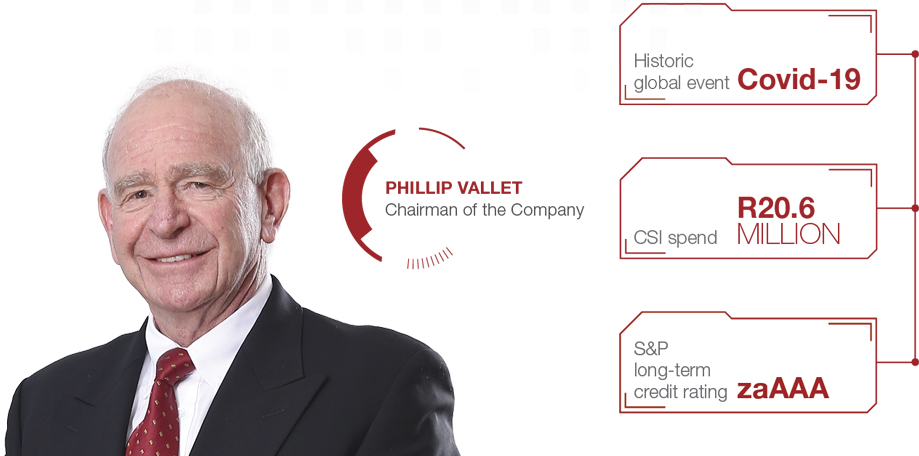
This has, without a doubt, been one of the most challenging years Super Group has experienced during my tenure as Chairman. The Group’s results for the financial year ended June 2020 reflect the uncertain and increasingly deteriorating economic climate, as well as the countless trading challenges the Group faced, both locally and globally. These tough conditions were exacerbated by the outbreak of the novel coronavirus, Covid-19, which resulted in countries and territories around the world enforcing lockdowns of varying degrees, effectively stopping the world in its tracks.
Super Group operates mainly in South Africa, Australia, the United Kingdom and Europe, all of which have had various lockdown measures and regulations in place since the middle of March 2020, severely impacting three full months of the financial year under review. Whilst certain countries have started easing lockdowns, we all find ourselves in unchartered territory when it comes to doing business.
The Group supports the various measures the South African Government implemented from midnight on 26 March 2020, as well as the procedures applied by other countries in which it operates to contain the spread of Covid-19.
As expected, the lockdowns had a significant impact on the Group’s performance, with the Board having to make a number of decisions based on the application of IFRS. This resulted in the impairment of goodwill, intangible assets and property in the amount of R895 million, mainly within Supply Chain Europe, Supply Chain Africa and Dealerships SA. The Board is comfortable with these impairments and continues to support the Group’s robust strategy.
Gender equality and employee transformation remain a key vision of the Group. We continue to acknowledge the principle that gender plays no part in merit and will actively ensure that women and men have equal opportunity to participate in management, at all levels. Super Group Holdings also maintained its Level 1 contributor B-BBEE status.
THE ENVIRONMENT IN WHICH SUPER GROUP OPERATES
Last year I mentioned that the global economy was likely heading towards a synchronised economic downturn, never expecting that the downturn would be closer to a complete meltdown, triggered by the pandemic. The Rand came under severe pressure against all major currencies, reaching record lows.
During the year under review, the South African Reserve Bank announced five interest rate cuts, one in July 2019 and another in January 2020, to provide some financial relief to consumers and to stimulate economic growth. The other three interest rate cuts in March 2020, April 2020 and July 2020 were to provide some relief as a result of Covid-19. Unfortunately, with South Africa having been awarded “junk status” by all the global rating agencies, the country went into recession prior to the pandemic. As retrenchments continue on the back of business closures due to the devastating impact of Covid-19, the already high unemployment rates are set to escalate – recent research indicates that 3 million people have already lost their jobs and 4.5 million have lost their income. The country is expected to be mired in a prolonged recession for the next two to three years.
The majority of Supply Chain Africa’s revenue is generated by the logistics relating to consumer goods, paper and pulp, packaging products, healthcare products, and commodity products (primarily coal), which were classified as essential products in South Africa for the purposes of lockdown regulations. That being said, the South African commodity operations have been negatively affected by the lockdown, seeing weak volume demand as the transportation of non‑essential services ground to a halt and the demand for coal was low given the warmer weather that lasted until late May. The consumer and convenience logistics businesses servicing the QSR and restaurant market, liquor distribution channels, forecourts at fuel stations, the tourism industry and the aviation industry came to a complete stop during the national 21-day hard lockdown, continuing into Level 3, which came into effect on 1 June 2020. The industrial-facing businesses were also significantly impacted by the lockdown, only supplying products to sectors providing essential goods until the end of May, with volumes picking up slightly under Level 3.
As Germany was not in a complete lockdown, but adhering to strict social distancing rules, a number of Supply Chain Europe’s customers still managed to operate. However, the European business faced tough trading conditions prior to Covid-19, with the business coming under additional financial pressure as a result of the automotive OEMs shutting down their plants in March and April. Germany’s annual growth rate in 2019 slowed to 0.6%, the weakest since 2013, with the economy expected to grow by 0.4% in 2020 and 0.9% in 2021. Government officials said the economy “remains in a weak phase” following “very weak” industrial production and a drop in incoming orders for manufacturing firms.
The Australian operations also faced a range of external challenges and it is fair to say that SG Fleet’s overall operating environment was mixed at best. The consumer businesses were impacted by worsening consumer sentiment in Australia, which saw demand for novated leases decline as spending on large ticket items, including cars, shrunk markedly. SG Fleet experienced a slowdown in New Zealand, although it managed to secure a significant contract which very positively benefitted the company.
Prior to Covid-19, Dealerships SA saw a further decline in new and used vehicle sales volumes, particularly in the premium segment, with Dealerships UK suffering a sharp decline in sales units. This was attributed to a decline in the Privilege Schemes activity levels as offered by the automotive OEMs. Both the South African and UK dealerships had to close all their dealerships from the end of March when lockdowns were imposed on non-essential businesses and only became fully operational towards the end of June 2020. These dealerships were also impacted by the shut-down of OEM plants as mentioned above.
The UK economy is on course to shrink by 12.4% in 2020, the biggest decline in 300 years, with borrowing set to rise to 104% of GDP. The fiscal watchdog warned that the economy would not get back to its pre-crisis size until the end of 2022, while the unemployment rate is likely to rise to a record 12% by the end of this year. Banks in the UK fear that up to 800,000 businesses may not recover in the next year as a result of the pandemic. Brexit negotiations, following Brexit D-Day on 31 October 2019, reached a deadlock following the outbreak of Covid-19. The withdrawal agreement offers an option of an extension of the transition period for one or two years, requiring the UK to make an appropriate financial contribution, as well as to continue following EU rules. The consensus seems to be a one-year extension to avoid uncertainty given the fragile state of the economy after the pandemic.

SUPER GROUP’S GOVERNANCE, ENVIRONMENTAL AND SOCIAL APPROACH
The Group’s Integrated Reporting process, as well as the content of this report, is guided by the principles and requirements of the International Integrated Reporting Framework, IFRS and the King Code of Governance Principles for South Africa and is in accordance with the ‘core’ option of the Global Reporting Initiative (GRI) Standards. Super Group continues to maintain and implement high standards of corporate governance. The Board and its committees strive to continually enhance good corporate governance and review sustainable practices throughout the Group to ensure compliance with all corporate governance- and sustainability-related requirements and regulations. The emerging global focus on Environmental, Social and Governance (ESG) performance by shareholders specifically is firmly on our radar and suitable attention is given to these matters.
Management meets regularly with various stakeholders as open communication is viewed as critical to the Group’s long-term success and to ensure that stakeholder matters and concerns, as far as possible, are addressed.
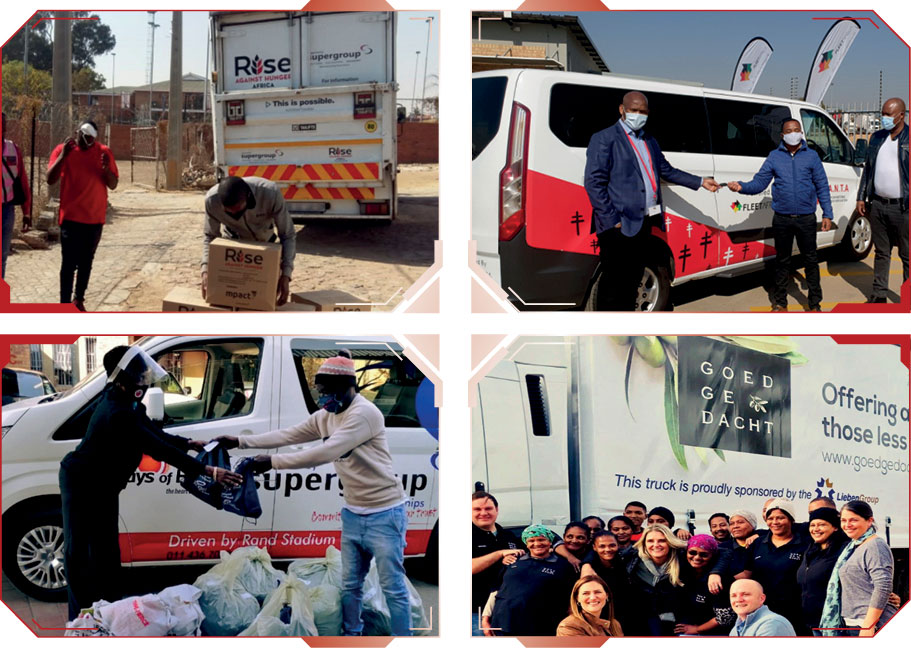
We take our role as a corporate citizen seriously as well as our impact on the environment. For the year ended 30 June 2020, Super Group spent R20.6 million on various CSI projects, an increase of 31.2% on the prior year. The implementation of the Carbon Tax was postponed until October 2020; however, this might be postponed again due to the pandemic. The external consultant employed by Super Group assisted with the measurement of the Group’s carbon emissions activities and the results are set out in the ESG Report.
Gender equality and employee transformation remain a key vision of the Group. We continue to acknowledge the principle that gender plays no part in merit and will actively ensure that women and men have equal opportunity to participate in management, at all levels. Super Group Holdings also maintained its Level 1 contributor B-BBEE status.
Our ESG Report sets out our principles and policies in more detail.
BOARD CHANGES
Mr John Newbury and Mr David Rose both retired at the AGM held on 26 November 2019. We thank them for their valuable input during the time they served on the Board as Independent Non-Executive Directors. They are sorely missed.
Mr Oyama Mabandla resigned effective 8 July 2020 due to an unforeseen conflict of interest. The Board would like to thank Oyama for his contribution since joining the Board in 2018 and wish him well in his new endeavours.
Ms Mariam Cassim will also be resigning from the Board effective 30 November 2020 due to increased executive commitments. We wish Mariam well with her business responsibilities.
In terms of King IV™, Mr Valentine Chitalu has been appointed as Lead Independent Director effective 30 September 2020. I look forward to working with Valentine as part of the Group’s Board succession plan.
On the positive side, Ms Pitsi Mnisi and Mr Simphiwe Mehlomakulu have been appointed to the Board as Non‑executive Directors with Ms Mnisi also being appointed as a member of the Group Audit Committee and Chairperson of the Group Social and Ethics Committee, both with effect from 1 October 2020. We look forward to working with them both into the future.
Mr John Mackay was appointed Group Company Secretary on 1 January 2020 following the retirement of Mr Nigel Redford on 31 December 2019. We would like to also thank Nigel for his contribution to the Group and wish him well and hope he enjoys his well-deserved retirement.
APPRECIATION
To Peter Mountford, his executive team and the Super Group employees, we extend our gratitude for navigating the Group through unchartered waters. This has been an exceptionally challenging year where the team had to adapt to a massively changed environment.
I would further like to extend my thanks to all stakeholders for your ongoing support and commitment.
Thank you to my fellow Board members, as always, for your continued support.
Phillip Vallet
Chairman of the Company
9 November 2020