
Dear stakeholders,
The economic and social sustainability as well as the governance of Super Group is of key importance to the Group. Effectively managing the consequences of the Group’s activities and upholding our commitment to all our stakeholders, not only secures trust, but ensures that Super Group maintains its reputation as a good corporate citizen, attract investors and be the “Employer of Choice”.
Mr Oyama Mabandla acted as Chairman of the Group Social and Ethics Committee until his resignation on 8 July 2020 and, on behalf of the Board, I would like to take this opportunity to thank Oyama for his valued contribution. Subject to my election as a non-executive director at the AGM on 18 December 2020, I am honoured to serve as Chairperson of the Group Social and Ethics Committee effective 1 October 2020.
A decision was taken to combine the Corporate Governance Report and Sustainability Report into a consolidated ESG Report for the year ended 30 June 2020. The Group Social and Ethics Committee (“the Committee”) assists the Board in monitoring Super Group’s performance as a good and responsible corporate citizen and performs its duties in terms of regulation 43 under the Companies Act.
This has been an extraordinary year given the Covid-19 pandemic, resulting in various forms of lockdowns across the world. The Group had to adapt to the “new normal” of doing business whilst ensuring that the environment in which our employees work, adhere to the necessary Covid-19 health and safety protocols. The cost of compliance to these Covid-19 protocols amounted to approximately R22.3 million. The Group had 261 employees who tested positive for Covid-19. The majority of employees self-isolated and were a-symptomatic. We unfortunately had two fatalities as a result of this devastating pandemic and our sincere condolences to their families. In response to Covid-19, Super Group has adopted Covid-19 health and safety protocols which are clearly outlined in the ESG Report.
Corporate governance within Super Group is managed and monitored by a unitary Board and the Group Audit Committee, supported by this Committee and other sub-committees of the Board. The Board’s responsibilities and terms of reference are detailed in the Board Charter. This charter has been developed to enable the directors to maintain effective control over strategic, financial and compliance matters, and is reviewed annually. Further, the charter is updated when required to ensure compliance with the Companies Act, King IV™ and the JSE Listings Requirements.
Super Group’s capacity to act as a responsible corporate citizen is directly impacted by its financial performance. The Group continues to focus on initiatives to significantly improve the lives of previously disadvantaged South Africans through training and mentorship.
Our value creation is closely connected to improving the lives and wellbeing of societies in the regions in which we operate. Across both our African and international operations, Super Group continues to invest in its people. Our employees are key to the success of our Group. Although the Group had to retrench employees as a direct result of Covid-19, our workforce increased by 1 279 employees across all regions on the back of the various acquisitions concluded during the year. Retrenchment costs, mostly associated with Covid-19, amounted to approximately R31.4 million. Despite retrenchments, we recruited 172 (2019: 222) unemployed Black learners as well as 32 (2019: 20) disabled Black ladies to participate in learnership programmes this past year. No bursaries were awarded during the year, however, the learnership programme currently has 184 students of which 104 are in the employ of Super Group.
The total number of accidents increased to 481 (June 2019: 332) mainly due to the unacceptable condition of our road infrastructure, the increasing criminal attacks on trucks and the lawlessness of drivers on our roads continue to increase. We had two fatalities, both in Supply Chain Africa, during the year and our condolences go out to their families and colleagues. We continue to strive for a zero-rate fatality level.
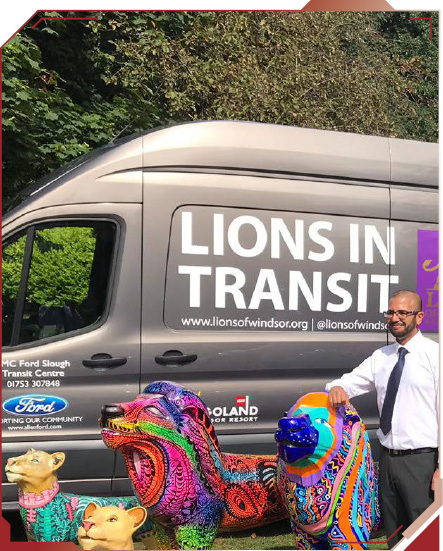
Super Group actively contributes to the social upliftment of previously disadvantaged communities as well as where there is a real need. We are aware of the devastating effect Covid-19 has had on the communities we operate in and as a result, we increased the Group’s total Corporate Social Investment contribution for the financial year ended 30 June 2020 to R20.6 million, an increase of 31.2% on the prior year’s R15.7 million. The various CSI initiatives undertaken by Supply Chain, Fleet Solutions and Dealerships are set out in more detail in the ESG Report.
In line with our overall approach to ESG principles, we have put in place a number of environmentally-friendly business practices across the Group, many of which also make good financial sense as they drive improved efficiencies at the same time. The Group reported a 10.5% decline in its carbon emissions from 390 134 tonnes (2019) to 349 107 tonnes mainly as a result of less traveling on the back of the various Covid-19 lockdowns. We also ensure that all vehicles are properly maintained and are not overloaded. Along with frequent driver training, this ensures that carbon emissions from all our vehicles meet manufacturers’ specifications. This in turn contributes to reduced pollution as well as better driving habits.
Despite Covid-19 and the dire impact it is having on world economies, Super Group acknowledges that there is more to be done. The following imperatives, forming part of the Group’s strategy, will provide the context for setting the Group’s sustainability targets going forward:
- actively contributing to the success of emerging entrepreneurs and supporting local initiatives;
- continuing to firmly embed sustainability management in all businesses;
- setting clear transformation and gender diversity targets;
- retention of key talent and succession planning; and
- enterprise and socio-economic development.

Composition and responsibilities
| Chairperson | Pitsi Mnisi (effective 1 October 2020) Oyama Mabandla (resigned effective 8 July 2020) |
| Members | Peter Mountford Simphiwe Mehlomakulu (effective 9 November 2020) Colin Brown (resigned effective 9 November 2020) Exco members (by invitation) |
| Independence | In terms of King IV™, the majority of Committee members should consist of non-executive directors. Super Group has taken a decision that the duties of the Committee overlap with certain duties performed by Remco, the Group Audit Committee and the Group Risk Committee and are therefore satisfied that all of the independent non-executive directors not serving on the Committee, are updated on all the social and ethics-related matters of the Group. Effective 9 November 2020, the majority of the members will be independent non-executive directors. |
| Secretary | John Mackay |
| Role and function | The Committee has a Board-approved Social and Ethics Charter which incorporates the responsibilities of the Committee and its terms of reference, aligned to the guidelines and requirements provided by the Companies Act and King IV™. |
| Responsibilities |
The Committee:
|
| Assurance |
The Committee hereby confirms that it has executed its duties in accordance with these terms of reference during the past financial year. Greenstone, an independent consultant, assists Super Group to collect, manage, analyse and report the data required to fulfil its ESG compliance reporting requirements in terms of monitoring the impact of the Group on the environment. |
Activities undertaken by the Committee during the year
The activities undertaken by the Committee during the year are set out in detail in the ESG Report that can be found on the Group’s website www.supergroup.co.za.
In addition, the Committee:
- reviewed the Group’s response to Covid-19 and that the Group complied with the Covid-19-related regulatory requirements as promulgated by the various governments. and receives reports on the number of infections and recoveries. It also assessed and reviewed the Group’s current and potential future scenarios and action plans;
- reviewed the Group’s transformation and gender equality targets to align with industry trends;
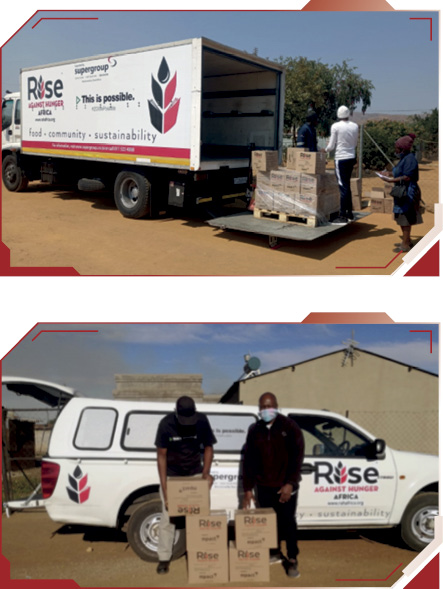
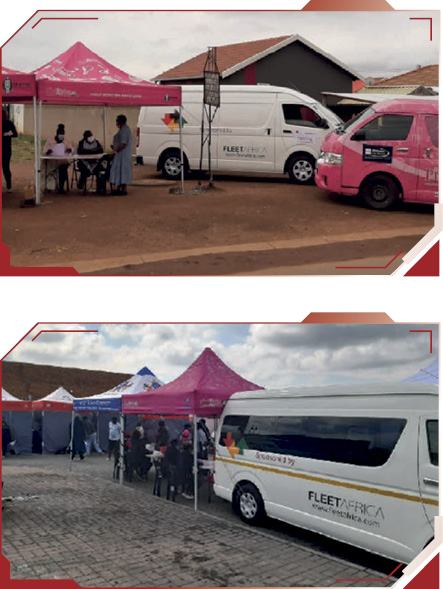
- critically reviewed CSI spend to ensure that the major CSI projects, like Rise Against Hunger Africa, Rays of Hope and the Pink Drive, are still being supported; and
- reviewed progress against the Group’s environmental targets.
Stakeholder engagement
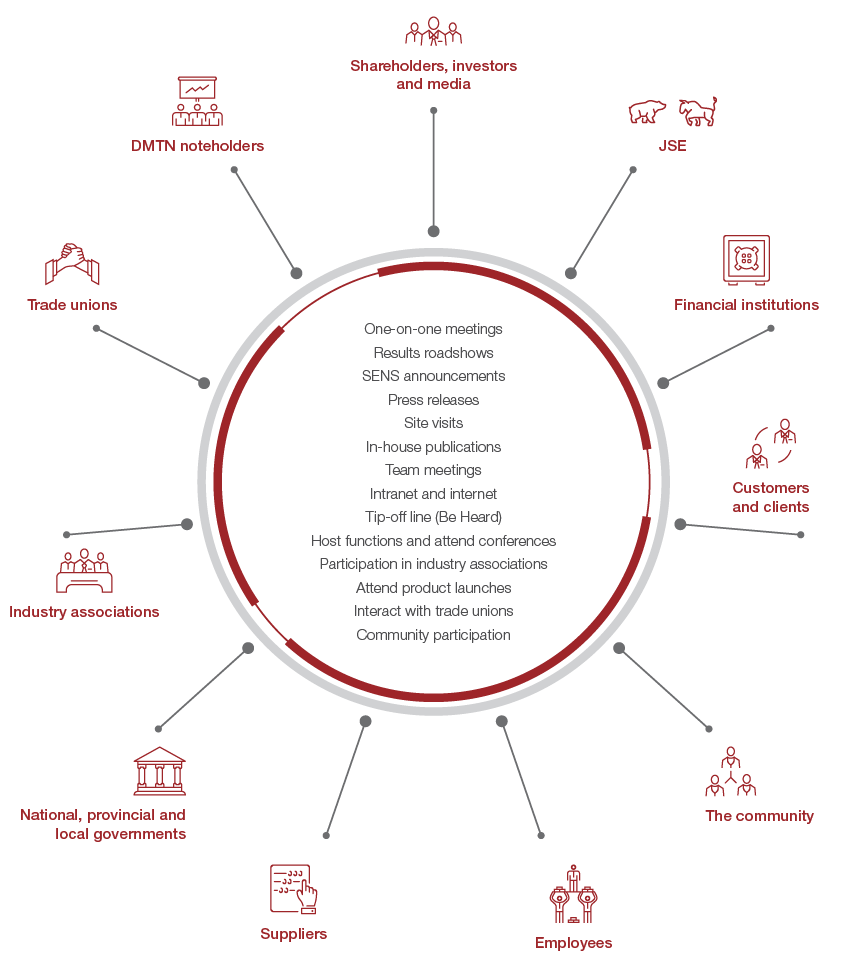
As promoted by King IV™, inclusive stakeholder engagement is encouraged whereby the Board considers the legitimate interests and expectations of stakeholders on the basis that is in the best interests of the Company, and not merely as an instrument to serve the interests of the shareholders.
The Companies Act also requires a Company to embrace engagement with its shareholders, employees, unions, communities and consumers. The Committee monitors and assists with stakeholder engagement.
Stakeholders are also considered when assessing the materiality of issues.
Super Group believes that open and transparent communication with stakeholders is important and uses many avenues to facilitate the engagement with its stakeholders on a regular and constructive manner. There are various internal functions within the Group to ensure that the needs and requirements of all stakeholders are addressed. The Committee, in conjunction with the Human Resources department and investor relations function, ensures that stakeholder engagement is executed.
For further details on the specific engagement with each of the stakeholder categories, as well as determining materiality when assessing the risks associated with Super Group’s business, see the ESG Report.
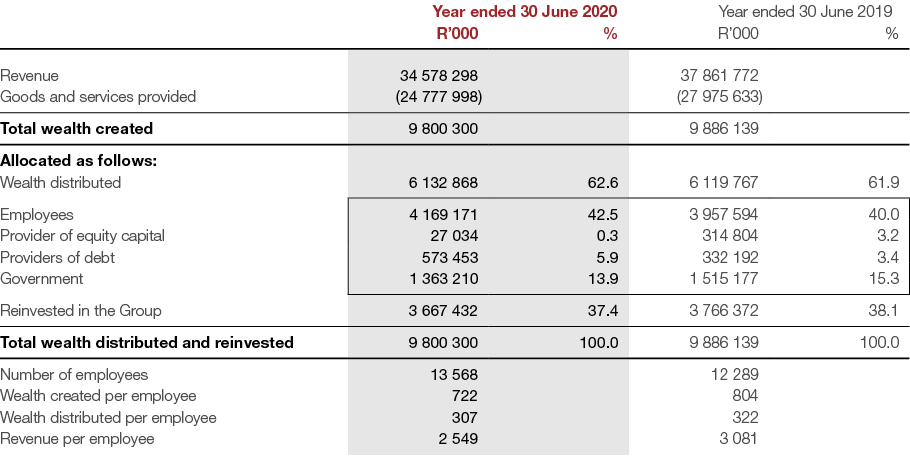
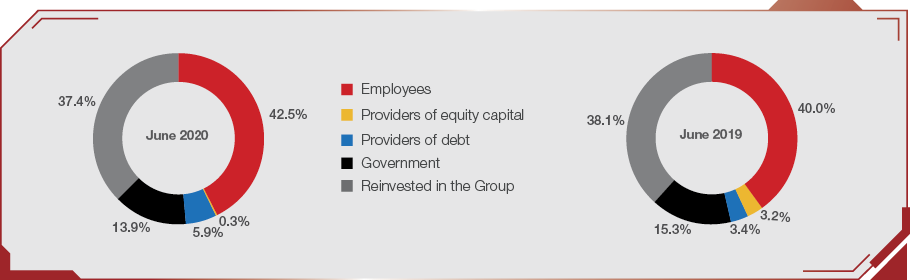
Value-Added Statement
A measure of the wealth created by Super Group, for various stakeholders, is the amount spent on the cost of goods and services provided, the remuneration paid to its employees, money paid to providers of equity and debt, taxes paid to Government and capital reinvested in the Group.
Outlook for 2021
The Committee is satisfied with the Group’s progress in the different areas and with the plans for the 2021 financial year. The Committee is aware its function will continue to evolve as it addresses all the responsibilities within its mandate as well as bring it in line with the King IV™ requirements.
The one critical area that has to be evaluated is the root causes of the accidents and fatalities reported for the year and the improvements in operating procedures and behaviours needed to prevent repeat occurrences. The Committee will also be reviewing the Group’s OHS reporting protocols to ensure applicable standards are consistently applied.
On behalf of the Group Social and Ethics Committee
Pitsi Mnisi
Chairperson of the Group Social and Ethics Committee
9 November 2020